

Identara Identara

Identity and access

Who walks in with which keys, and is that still right?


The wall and the moat are still standing, and you need them. The network, however, is no longer the border. Identity is, and that calls for a different kind of examination. Identara assesses who can reach your systems, why it was set up that way, and whether it is still defensible.

A navy key whose bit is formed by glowing fingerprint ridges and whose head holds a network of connected nodes
20 yearsIdentity and access management at large organisations in the Netherlands and Belgium
IndependentVendor-neutral, no licence sales and no supplier interest
One point of contactYou speak to the adviser doing the work, not to an account manager
DemonstrableAligned with ISO 27001, NIST CSF 2.0, CIS Controls v8 and the CBCS information security guidelines

Why this matters now

The wall is still standing, but it is no longer the whole border

For a long time an IT environment was much like a castle. One wall, a moat, a handful of guarded gates. Anyone already inside was trusted. That approach was right, for that landscape.

Today the castles are all connected. Cloud, remote working, suppliers, customer portals, devices logging in from anywhere. Every connection is another gate, and by no means all of those gates stand on your own ground.

What remains as the border is identity. The attacker forces nothing, he logs in. With a stolen password, a phishing email that worked, or the account of a former employee who left long ago. No alarm goes off, because the system does exactly what it was built to do.

The questions we ask

  1. 01

    Who has access to what, people and technical accounts alike, and is that access still needed today?

  2. 02

    Who granted those rights, on what grounds, and when was that last reviewed?

  3. 03

    Can one person complete an entire transaction alone, or is segregation of duties demonstrable?

  4. 04

    What happens to the access of an employee, a supplier or an administrator who leaves?

What sets us apart

A pen test finds step one. The damage happens in steps two to six

A penetration test shows that someone can get in. Usually the story stops there. We follow the chain further, because it is only after that first access that it gets expensive.

A navy panel with a glowing keyhole shaped as a node, connected to three other nodes one of which is lit
STEP 1Initial accessA phishing email, a stolen password or a flaw in an application
STEP 2Looking aroundThe attacker maps users, groups and administrator accounts
STEP 3Escalating rightsAbuse of excessive rights or a forgotten administrator account
STEP 4Moving furtherFrom one system to the next, using valid credentials
STEP 5Reaching the dataAccess to customer data or financial systems, without any alarm going off
STEP 6Staying putA back door for later, overlooked during the clean-up
What an ordinary penetration test covers What Identara looks at

We test the front door and assess the set of keys, and deliver one account of it rather than two separate reports.

How we look at your environment

Four principles

Visible before defensible

As long as nobody has an overview of rights, any judgement about risk is a guess.

Rights go stale

Access that was once justified rarely still is after a reorganisation or a departure.

Evidence over assurance

A control you cannot evidence does not exist as far as an auditor or regulator is concerned.

Judgement stays human work

Tooling finds anomalies. Whether something is a problem depends on what your organisation does.

What we deliver

Seven services, available separately, together a complete picture

Most organisations begin with an analysis or an assessment of their systems. Where are the weak spots, and what is already sound. That makes the picture visible quickly and takes comparatively little time.

Identara assesses that outcome from the perspective of identity and access, and for each part brings in the specialist who is strongest at it. Where you want it, we build a roadmap from the risks and bottlenecks found, resolving them step by step. You have one point of contact, and we set the scope together with you beforehand.

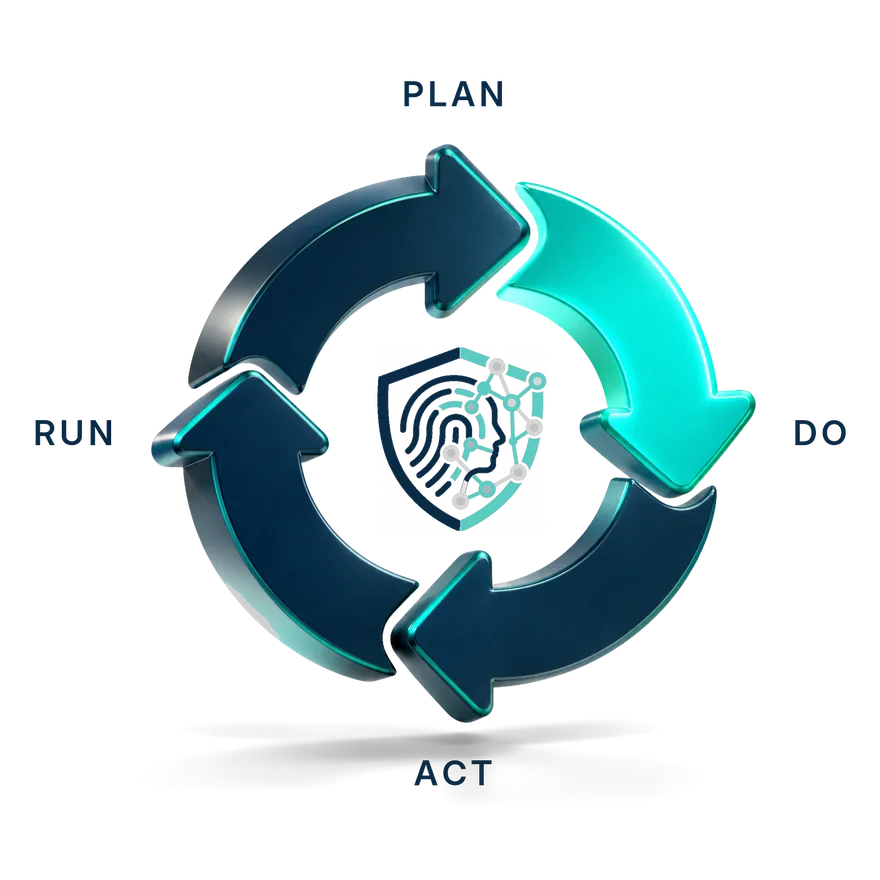
The Identara cycle, four curved arrows running clockwise through PLAN, DO, ACT and RUN, with the Identara shield at the centre

PLAN

Establishing where you stand

A one-hour scoping conversation, then the review within the agreed boundaries. You receive a maturity score per area and you know what you have to comply with.

Identity and access review

Who has access to what, and is that still right?

Employees, customers, suppliers and administrators come in via the office, from home, through cloud and portals, each combination with its own rights. We walk through them all, including accounts of departed staff, excessive rights, forgotten administrative access and the test on segregation of duties.

Without classification, every access review is an opinion. We therefore also establish which data sits behind the access and who owns it.

A maturity score per area and an improvement path with measurable steps  ·  two to six weeks

Compliance and audit readiness

Can you demonstrate that it is in order?

Translating requirements into concrete controls, for ISO 27001, NIST and the information security provisions of the Central Bank of Curaçao and Sint Maarten. An assessment of access management and segregation of duties in the light of supervision, and the evidence an auditor wants to see.

A gap analysis, a prioritised plan and the supporting documentation  ·  three to six weeks

DO

Testing whether it holds up in practice

Targeted testing where the review gives reason for it, rather than everything as standard. Serious findings reach you during the work, not only in the report.

Vulnerability assessment

Where are the weak spots, and which ones are genuinely dangerous?

An inventory across the full landscape, not only the systems already in view. Automated scanning followed by manual verification, so the false positives are removed.

An overview ranked by real impact  ·  one to two weeks

Penetration test

Can someone get in, and how far do they get?

A controlled attack on network, systems or web applications, following international standards including the OWASP Top 10. From outside without prior knowledge, or from inside with a user account.

Findings with severity and evidence, plus a prioritised remediation list  ·  two to four weeks

Social engineering and awareness

How resilient are the people, not just the systems?

Simulated phishing emails, tailored to your organisation and language, measured per department. Optionally a physical access test. Follow-up with targeted training rather than a generic course.

Measured results per department and a targeted training proposal  ·  two to three weeks

ACT

Improving, yourself or with the right party

Not everything can happen at once. Findings are weighed on what they can actually cost you, not on a default score from a scanner. Then comes the work itself, by your own people or by a party you choose on well-founded grounds.

Advice and guidance

A report changes nothing, carrying it out does.

Translating findings into a plan that fits your size and budget. Guidance for your own people or for the party doing the implementation, until it demonstrably works.

Where a decision rises above the technology, for instance who becomes the owner of an access decision, we put the choice in front of you together with its consequences.

A roadmap with owners and deadlines, plus a repeat measurement afterwards  ·  by arrangement

Independent vendor selection and tendering

Who is going to build this, and how do you know they are the right party?

Translating your requirements into a specification, an RFP or tender documents. A weighting model that matches what actually matters to you, assessment of the submissions and a substantiated selection recommendation. We know the platforms and the suppliers from the inside, including what they deliver in practice.

You pay us to determine which choice is the right one, not to sell you one. We carry no licences and are tied to no supplier.

Specification, weighting model and selection recommendation  ·  four to eight weeks, fixed price

RUN

Keeping it demonstrable

A repeat measurement on the same scale shows that the improvement is really there. That is also exactly what an auditor or a supply-chain partner wants to see from you. RUN is not a separate service, it is the form the work takes once it is running.

Annual repeat measurement

A subscription in which we measure again once a year on the same scale, so that you see the trend and not only the snapshot.

Hand-over after tender

If you selected a party through us, the work moves to them. We stay on your side of the table and check that what was agreed is what gets delivered.

Delivery with a partner

Where you do not have the capacity yourself, we bring in a partner who takes over the day-to-day management, under the same agreements and with the same measurement.

Approach

Where you step in, and what is fixed beforehand

Formally the cycle begins with planning. In practice almost every organisation steps in at a test, because that shows fastest where it stands. That is fine, as long as you then enter the cycle instead of filing the report away.

01

Scope

A one-hour scoping conversation. What falls within the boundaries, and what does not, is fixed beforehand. A fixed price, and no open end.

02

Delivery

The review within those boundaries. Serious findings reach you during the work, not only on delivery.

03

Reporting

An explanation for the board and a separate technical annex for IT. Two readers, two languages, the same underlying facts.

04

Follow-up

A plan with owners and deadlines, and a repeat measurement that shows the improvement is really there.

About Identara

One specialism, deep enough to pass judgement on it

Identara does one thing: assess who has access to what, and whether that is still defensible. Behind the brand stands Dave Vijzelman, over twenty years in identity and access management at large organisations in the Netherlands and Belgium, in healthcare, energy, financial services, education and utilities.

The approach is vendor-neutral. Identara sells no licences and does not implement. Product knowledge runs deep enough to see through the differences between platforms, and that is exactly what makes an independent judgement usable. What one vendor calls a role is something else at the next one.

SpecialismIdentity governance, access management, privileged accounts, segregation of duties and federation
FrameworksISO 27001 and 27002, NIST CSF 2.0 and SP 800-53, CIS Controls v8, COBIT, and the information security provisions of the Central Bank of Curaçao and Sint Maarten
LanguagesDutch and English, in conversation and in reporting
Area servedBelgium, the Netherlands, Suriname and the Caribbean

Who does the work

Identara is your contracting party. We set the scope together with you, oversee the work and deliver the report.

For each part we bring in the specialist who is strongest at it, with certified testers for the offensive work, under contract with us.

You know in advance who comes onto your systems. One point of contact, one report, no separate suppliers for you to manage.

What Identara does not do

No licence sales, no implementation, no management. That keeps the judgement free of any interest in the outcome.

Contact

Start with a one-hour scoping call

No obligation, and it gives you a concrete proposal at a fixed price. No commitment to continue afterwards.

Email info@identara.one
Phone +32 (0)471 097 376